
Brand color isn’t a suggestion. For your customers, that specific shade of red or precise teal is baked into their brand standards and defended fiercely by their marketing teams. When it shifts between runs, or worse, within a run, the conversation gets uncomfortable fast.
Label Printing Color Accuracy: How to Hit Brand Color on Every Short Run
Short run label printing makes this harder. Less time to dial in, fewer meters to absorb setup variance, and the expectation that color walks out the door matching the last job, the job before that, and the approved standard. That’s real pressure, and it’s where label printing color accuracy either becomes a competitive advantage or a recurring headache.
The Short Run Problem Isn't the Run Length
Here’s something worth saying plainly: short runs don’t cause color problems. They expose them.
Longer runs give you room to correct. You spot the drift, adjust, and the bulk of the job looks fine. Shorten that run, and there’s no recovery window. Whatever process variability exists in your setup shows up immediately, and sometimes ships before anyone catches it.
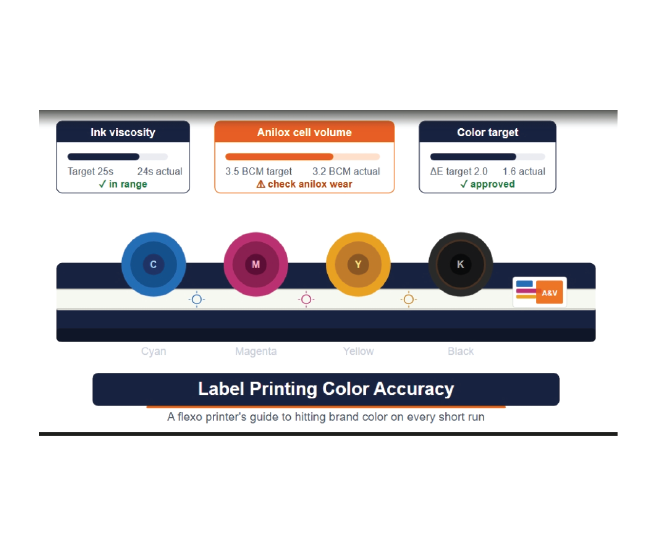
Short run label printing color accuracy depends on controlling the variables that longer runs let you paper over. Ink viscosity, anilox condition, impression settings, and substrate consistency are where you start.
Where Color Drift Actually Comes From
Most color inconsistencies trace back to a handful of root causes that get ignored until they’re expensive.
Anilox wear and contamination top the list. A partially plugged cell doesn’t deliver consistent ink volume, and inconsistent ink volume means inconsistent color density. When it comes to color consistency in label printing, regular anilox cleaning and periodic cell volume audits are not just optional maintenance; they are foundational for success.
Ink viscosity is another one. Flexo inks are sensitive to temperature and time. Viscosity that’s even slightly off changes how ink transfers to the substrate and how that color reads on the finished label. Checking viscosity at the start of every run, not just at mixing, matters more than most operators realize.
Impression settings deserve attention, too. Uneven or excessive impression affects how ink lays down on the substrate, which directly impacts color density and dot quality. Dialing in the right impression for each job and documenting it for repeatability is one of the fastest wins available to most label printing operations.
Substrate variability is less obvious but just as real. Switching between suppliers or grades of the same material mid-product line introduces surface energy and caliper differences that affect both ink adhesion and how color appears on the finished label. Consistency in substrate sourcing is part of the color accuracy equation.
Build a Process, Not a Habit of Heroics
Improving label printing color accuracy at scale isn’t about skilled press operators saving jobs through intuition and last-minute adjustments. It’s about building a process where color accuracy is the default output rather than something achieved through effort on every run.
A few practices that make a measurable difference:
Establish ink draw-down standards for each brand color and keep them accessible at the press. When operators have a physical reference, color drift gets caught early rather than after the job ships.
Document anilox specifications by job type and match line screen and cell volume to the application requirements. The right anilox for the job is not the same as the closest available one, and the difference shows up in color.
Track impression settings by job and substrate. Recreating what worked last time is far faster than re-dialing from scratch, and it removes a significant source of run-to-run color variation.
Invest in a spectrophotometer-based color measurement if you aren’t already. Delta E tolerances that were acceptable a few years ago are getting tighter across the industry. Having objective measurement data at press-side removes the subjectivity from color approval and gives you something concrete to reference when a customer pushes back.
Color Accuracy as a Differentiator
Brands are getting more precise about color standards, not less. The label is often the first thing a packaging buyer examines on a new production run, and label printers who consistently deliver within tolerance win repeat business and referrals.
The operations that get there aren’t necessarily running newer equipment. They’re running tighter processes, and they’ve eliminated the variables that make color accuracy feel like luck rather than craft.
Anderson & Vreeland’s technical team works with flexographic printers on exactly these kinds of process challenges. If short run label printing color accuracy is a recurring issue in your operation, a conversation with our specialists is a practical place to start.
When the Pressroom Runs Thin on Experience
The flexographic industry is in the middle of a knowledge transition that isn’t going to reverse itself. Experienced press operators who could read a job by instinct, catch a color shift before it became a problem, and know exactly which variable to touch first are becoming harder to find. That’s not a criticism of newer operators; it’s a structural reality of where the industry is right now. When that depth of experience isn’t sitting on your pressroom floor, process documentation and outside expertise fill the gap. Anderson & Vreeland’s field services team brings an outside perspective that isn’t anchored to one press brand, one ink supplier, or one way of doing things.
We’ve seen the same color accuracy problems play out across a wide range of operations, and that breadth matters. A fresh set of eyes on your anilox program, your ink management process, or your impression documentation often surfaces something that’s been quietly costing you on every short run. If your team is doing their best with limited resources and limited experience depth, that’s exactly the situation a consultation is designed for.